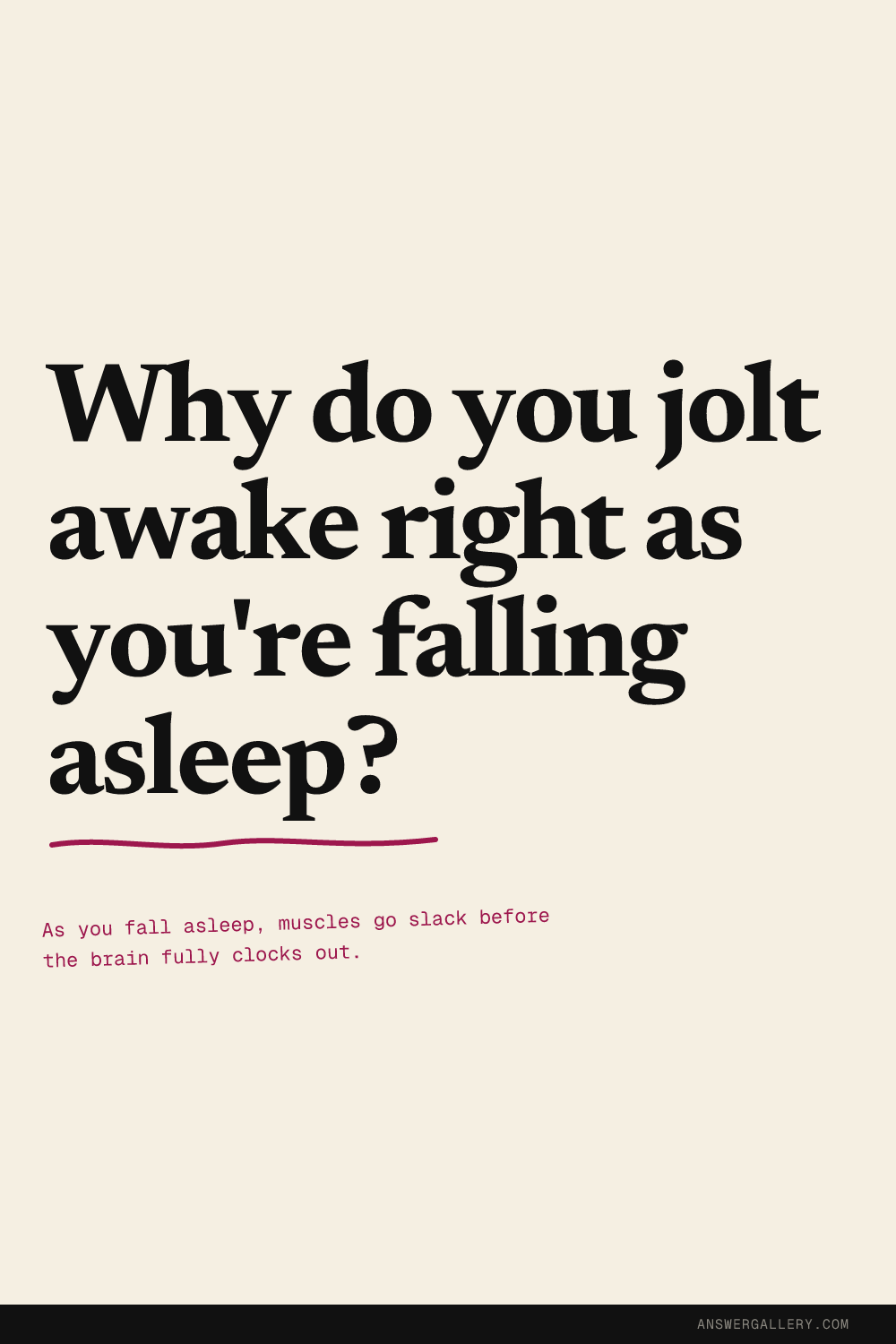
Why do you jolt awake right as you're falling asleep?
←→to navigate
Slide 1 of 8
tl;dr
As you fall asleep, muscles go slack before the brain fully clocks out. Your brainstem can misread that slackness as an actual fall and fire an emergency catch reflex — the hypnic jerk. About 70% of people get them; they're harmless.
Show the written answerThe written answer
Filed under mysteries that solve themselves at 11:47 p.m.: you're drifting off, warm and boneless, when your whole body flinches like it missed a stair. That's a hypnic jerk — the sleep world's name for the jolt — and the case notes point to a handoff error inside your own head. As you fall asleep, your brain powers down in sections, not all at once. Your muscles go slack early. Somewhere in the brainstem, an older, jumpier system reads that sudden slackness the way it would read an actual fall — and slams the emergency brake. One full-body twitch, sometimes with a flash of a dream about tripping off a curb, and you're briefly, indignantly awake.
The handoff error
Falling asleep is not a light switch; it's a shift change. The thinking brain clocks out while deeper systems are still mid-paperwork. When your muscles let go faster than the monitoring systems expect, the mismatch registers as trouble. The brainstem doesn't deliberate — it's the part of you built for catching yourself — so it fires a fast, powerful signal to your muscles. The jerk is your body catching a fall that never happened.
Why the falling dream?
Here the desk notes get charming: your brain hates an unexplained alarm. When the jolt fires, the drowsy mind sometimes back-fills a story to match the sensation — a stumble, a missed step, the ground giving way. The dream doesn't cause the jerk; the jerk commissions the dream, retroactively, like an editor writing a headline after the page has already printed.
Who's on the list
Roughly 70 percent of people experience these jolts at some point, so this is less a disorder than a feature of the shift change. But some things make the alarm twitchier: caffeine late in the day, stress that keeps the alert systems half-staffed, hard exercise close to bedtime, and plain sleep deprivation — a brain crashing into sleep too fast is easier to startle. The jolts are harmless. Annoying, occasionally partner-kicking, but harmless. If they arrive nightly in clusters or come with other symptoms, that's a note for a doctor; otherwise, close the file and go back to sleep.
cited
Sources
- [01]What are Hypnic Jerks — McGill Office for Science and Society
“If you ever twitch while falling asleep, you're not alone. In fact 70% of the population experience this phenomenon, called a hypnic or hypnagogic jerk.”
- [02]Hypnic Jerk: Why You Twitch When You Sleep — Sleep Foundation
“Hypnic jerks are sudden, involuntary muscle contractions as you're falling asleep or while you're sleeping.”
people also ask
Keep asking
Are hypnic jerks dangerous or a sign of a sleep disorder?
No — they're considered a normal part of falling asleep and affect most people at some point. Only frequent, disruptive episodes or ones paired with other symptoms are worth mentioning to a doctor.
Why does the jolt come with a dream of falling?
The drowsy brain dislikes unexplained alarms, so it back-fills a story that matches the sensation — a stumble or missed step. The jerk comes first; the mini-dream is written after the fact.
Can I make hypnic jerks happen less often?
You can calm the triggers: less caffeine late in the day, no hard workouts right before bed, more consistent sleep, and lower evening stress. A brain that eases into sleep is harder to startle than one crashing into it.
same shelf
Related questions
Why does scrolling your phone in bed keep you awake — even on night mode?
Why do dreams vanish from memory minutes after you wake up?
Why do you get a second wind right when you should be going to bed?
Why does a warm shower before bed help you fall asleep faster?
Why does sleeping in on weekends make Monday feel worse?